
If your business is exploring immersive technology in 2026, you’ve almost certainly encountered the terms AR, VR and MR. They’re used interchangeably in marketing materials, thrown around at tech conferences, and referenced in countless investment reports — but they mean very different things, and choosing the wrong one for your project could cost you significant time and money.
This guide cuts through the confusion. By the end, you’ll know exactly what AR vs VR vs MR means, how they differ technically, which industries use each one, and — most importantly — which is right for your specific business goal.
What Is AR vs VR vs MR? A Simple Definition
Before diving into the technical differences in the AR vs VR vs MR debate, here’s the simplest possible explanation:
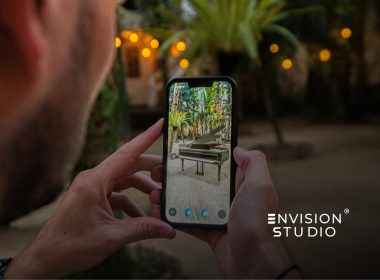
Augmented Reality (AR) adds digital content on top of the real world. You can still see your physical environment — a digital layer is placed over it through your smartphone, tablet, or AR glasses.
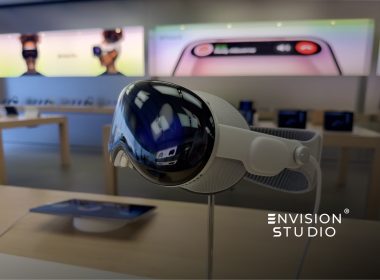
Virtual Reality (VR) replaces your entire environment with a digital one. You wear a headset like Meta Quest or Apple Vision Pro and are completely immersed in a virtual world.
Mixed Reality (MR) blends real and virtual worlds so that digital objects can interact with the physical environment in real time. Unlike AR, MR digital objects understand and respond to the physical space around them.
Understanding AR vs VR vs MR at this level is enough to start making strategic decisions for your business — but the deeper you go, the more valuable the distinction becomes.
AR vs VR vs MR — The Technical Differences
Augmented Reality (AR)
Augmented Reality works by overlaying computer-generated images, videos, or 3D models onto a live view of the physical world. The key technologies behind AR include Apple ARKit, Google ARCore, and Vuforia.
AR applications run on smartphones, tablets, AR glasses, and web browsers — making them the most accessible of the three in the AR vs VR vs MR comparison. No special hardware is required for the user beyond a capable smartphone.
How AR works technically: The device camera captures the real world, computer vision algorithms identify surfaces and objects in the scene, and digital content is rendered and overlaid on the camera feed in real time. The result is that virtual objects appear to exist in the physical space.
AR hardware:
- Smartphones and tablets running iOS or Android
- Microsoft HoloLens
- Meta Quest in passthrough mode
- Apple Vision Pro
- Web browsers via WebAR
Virtual Reality (VR)
Virtual Reality replaces your entire field of view with a computer-generated environment. Unlike AR in the AR vs VR vs MR comparison, VR completely removes the user from their physical environment — they see, and in many systems hear and interact with, only the virtual world.
VR is experienced through dedicated headsets that track the user’s head movements and adjust the displayed image accordingly, creating a convincing sense of presence inside a digital space.
How VR works technically: VR headsets use two displays — one for each eye — combined with lenses to create a stereoscopic 3D image. Head tracking sensors detect movement and update the view in real time. High-end systems add hand tracking, room-scale movement, and haptic feedback for deeper immersion.
VR hardware:
Mixed Reality (MR)
Mixed Reality sits at the most sophisticated end of the AR vs VR vs MR spectrum. Where AR overlays digital content on the real world, MR allows digital objects to understand and interact with the physical environment in real time.
A virtual ball in an MR application doesn’t just float over your desk — it bounces off the surface, rolls around your keyboard, and responds to the physical objects in the room. This spatial awareness is what defines MR and separates it from AR in the AR vs VR vs MR discussion.
How MR works technically: MR devices use depth sensors, cameras, and spatial mapping algorithms to build a real-time 3D model of the physical environment. Digital objects are then rendered into this model with accurate physics and occlusion — meaning they can go behind physical objects, cast shadows, and interact realistically with the space.
MR hardware:
- Microsoft HoloLens 2
- Apple Vision Pro
- Meta Quest 3 with mixed reality mode
AR vs VR vs MR — Which Industries Use Each?
Understanding AR vs VR vs MR by industry is one of the most practical ways to determine which technology is right for your business.
Industries Using AR
Retail and e-commerce — AR product visualization lets customers see how furniture looks in their home before buying. Brands like IKEA, Wayfair and Sephora have deployed AR try-on and visualization tools that significantly increase purchase confidence and reduce returns.
Marketing and brand activation — AR filters, branded experiences, and interactive packaging use ARKit and ARCore to create memorable, shareable brand moments at scale.
Field service and maintenance — AR overlays step-by-step instructions onto physical equipment, guiding technicians through complex procedures without requiring them to consult manuals or contact support.
Education — AR brings textbooks to life, overlaying 3D models of the human body, historical artefacts, or scientific phenomena onto physical pages.
Navigation — AR wayfinding overlays directions onto the real world through smartphone cameras, making navigation more intuitive in complex environments like airports and hospitals.
Industries Using VR
Industrial and workforce training — VR training simulations allow employees to practice dangerous, complex, or costly procedures in a safe virtual environment. Applications span construction safety, surgical training, military readiness, emergency response, and equipment operation. Our VR training solutions serve clients across Singapore, Europe and Asia.
Real estate and architecture — VR walkthroughs allow buyers and investors to experience properties before they’re built. Architectural firms use VR to review designs at human scale before committing to construction.
Healthcare — VR is used for surgical training, patient rehabilitation, pain management, phobia treatment, and medical education. The ability to simulate realistic medical scenarios without risk to actual patients makes VR uniquely valuable in healthcare.
Gaming and entertainment — VR gaming on Meta Quest, PlayStation VR, and Steam VR delivers immersive entertainment experiences that are impossible to replicate on flat screens.
Corporate training and onboarding — VR onboarding simulations allow new employees to experience their workplace, meet virtual colleagues, and practice key procedures before their first day.
Industries Using MR
Manufacturing and engineering — MR overlays digital assembly instructions, quality control data, and diagnostic information onto physical machinery in real time, dramatically improving efficiency and reducing errors.
Surgery and medicine — MR allows surgeons to overlay patient imaging data — CT scans, MRI results — directly onto the patient’s body during procedures, improving precision and outcomes.
Collaboration and remote work — MR enables distributed teams to work together in a shared spatial environment, manipulating virtual 3D models and data as if they were physically co-located.
Architecture and design — MR allows architects and clients to walk through virtual buildings placed accurately in their real-world context, experiencing scale, proportion, and spatial relationships before construction begins.
AR vs VR vs MR — Cost Comparison for Businesses
One of the most practical dimensions of the AR vs VR vs MR decision is cost. Here’s a realistic breakdown:
| Technology | Development Cost Range | Hardware Required | Accessibility |
|---|---|---|---|
| AR (mobile) | $15,000 — $80,000 | Smartphone only | Very high |
| AR (glasses) | $50,000 — $200,000+ | AR glasses | Medium |
| VR | $20,000 — $150,000+ | VR headset | Medium |
| MR | $50,000 — $300,000+ | MR headset | Lower |
These are indicative ranges — actual costs depend on complexity, interactivity, number of assets, and platform requirements. Working with an XR development outsourcing studio like Envision Studio based in Sri Lanka can reduce these costs by 60-70% compared to equivalent studios in the US, UK or Singapore.
AR vs VR vs MR — Which Is Right for Your Business?
The answer to the AR vs VR vs MR question depends entirely on what you’re trying to achieve. Here’s a practical decision framework:
Choose AR if:
- Your users will experience your product on their own smartphones — no hardware purchase required
- You need to overlay information onto real-world objects or environments
- You want to reach the widest possible audience at the lowest barrier to entry
- Your use case involves marketing, retail, field service, or navigation
Choose VR if:
- You need to fully immerse users in a simulated environment
- Your use case involves training for high-risk or high-cost real-world scenarios
- You want to create experiences that are impossible in the physical world
- Your users will be in a controlled environment — a training room, an office, a facility
Choose MR if:
- You need digital objects to interact intelligently with the physical world
- Your use case involves complex manufacturing, surgical, or engineering workflows
- You need remote collaboration in a shared spatial environment
- Budget and hardware accessibility are less of a constraint
How Envision Studio Can Help
At Envision Studio, we have delivered AR, VR and MR projects across multiple industries and countries — including government institutions, global enterprise brands, and consumer app markets on the App Store, Google Play, Meta Store and Steam.
Our team is fluent across Unity, Unreal Engine, Apple ARKit, Google ARCore, visionOS, Meta SDKs, HTC Vive, Pico VR and Steam VR — giving you a genuine one-stop studio for everything across the AR vs VR vs MR spectrum.
Whether you’re not yet sure which technology is right for your project or you have a fully scoped brief ready to build — our free 30-minute discovery call is the fastest way to get clarity.
👉 Book your free discovery call →
Frequently Asked Questions — AR vs VR vs MR
What is the main difference between AR vs VR vs MR? AR adds digital content to the real world through a camera, VR replaces the real world entirely with a digital environment, and MR allows digital objects to interact intelligently with the physical world. The key distinction in the AR vs VR vs MR debate is the level of immersion and interaction with the real environment.
Which is more expensive — AR, VR or MR? In the AR vs VR vs MR cost comparison, mobile AR is typically the most affordable to develop and deploy since users only need a smartphone. VR requires a headset purchase but development costs are comparable. MR is generally the most expensive due to the complexity of spatial mapping and the cost of MR hardware.
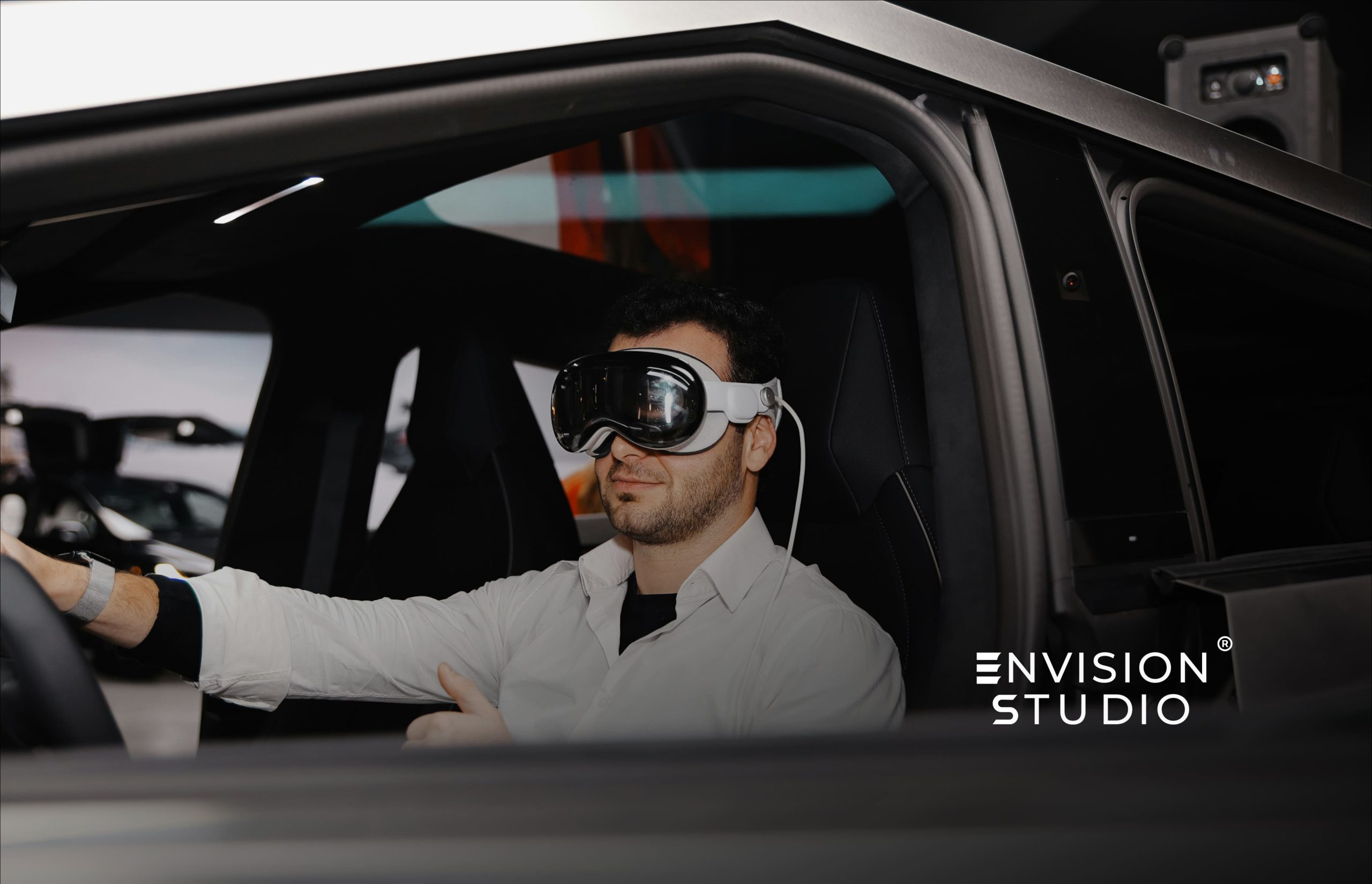
Is Apple Vision Pro AR, VR or MR? Apple Vision Pro is primarily a mixed reality device — it blends digital content with the real world using passthrough cameras and spatial computing. It can also operate in fully immersive VR mode. In the AR vs VR vs MR classification, Apple Vision Pro sits closest to MR.
Which technology is best for employee training? VR is generally the most effective technology for employee training in the AR vs VR vs MR comparison. It provides full immersion in simulated environments — ideal for safety training, emergency response, equipment operation, and surgical procedures. However, AR is often more cost-effective for simple guided workflow training that can be delivered on smartphones.
Can a single XR development studio build AR, VR and MR? Yes — a full-service XR development studio like Envision Studio covers the complete AR vs VR vs MR spectrum. Our team delivers mobile AR applications, immersive VR simulations, mixed reality enterprise tools, and Apple Vision Pro spatial computing experiences for clients across the US, Canada, Europe, Singapore and Japan.
How long does it take to build an AR, VR or MR application? Timelines vary by complexity. A simple mobile AR application might take 6-10 weeks. A full enterprise VR training simulation typically takes 12-20 weeks. MR applications for platforms like HoloLens 2 or Apple Vision Pro typically range from 16-24 weeks depending on scope. Book a free discovery call for a timeline specific to your project.