

 stargaze_admin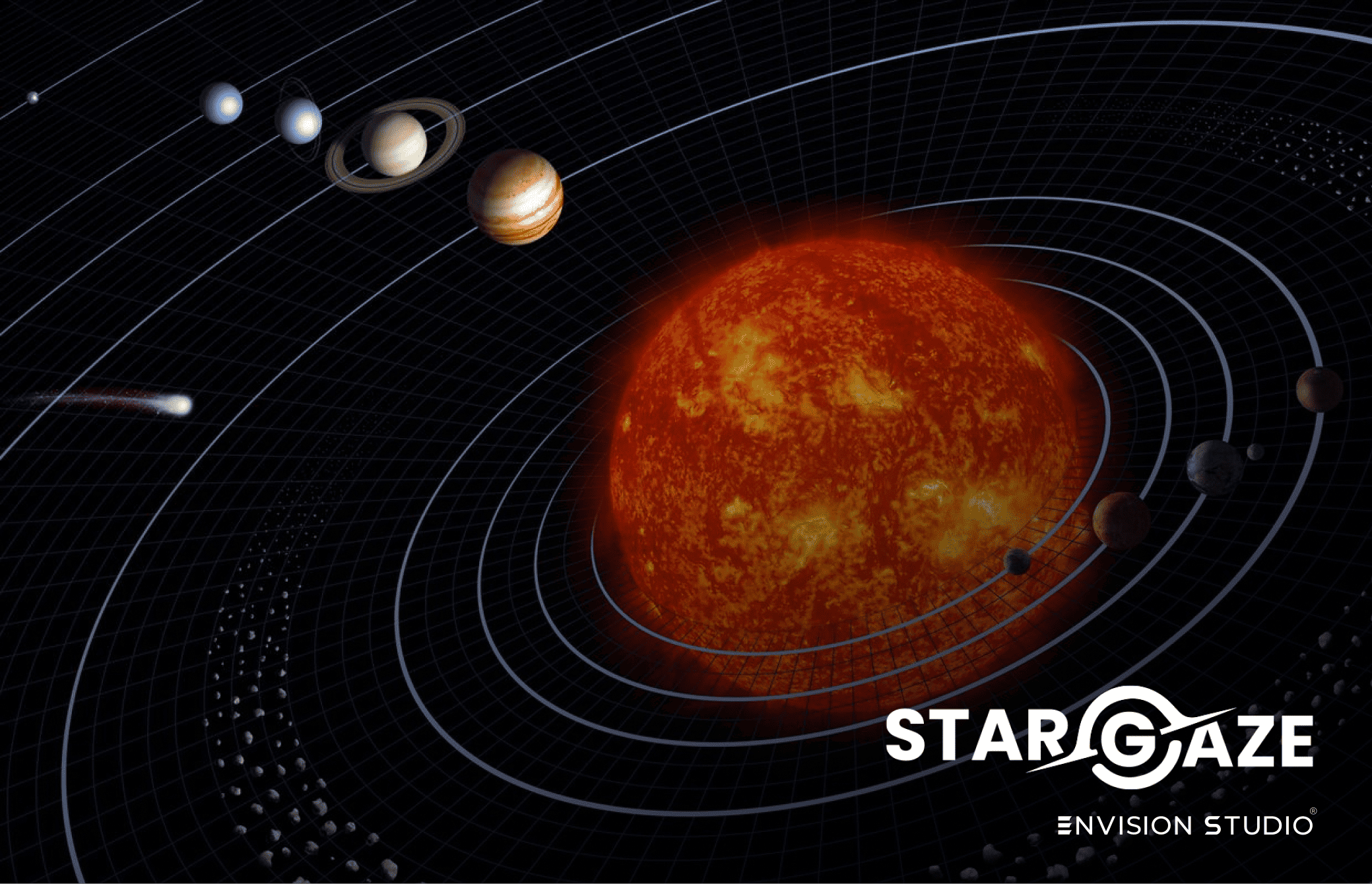
Solar system planets — nine worlds of extraordinary diversity orbiting our Sun, each with its own character, history and mysteries. And in 2026 you can place every single one of them in your living room using augmented reality.
Solar System Planets: The Complete Guide to Every Planet in AR in 2026
The solar system planets span distances and sizes so vast they are almost impossible to comprehend from a textbook or a flat image. Jupiter is so large that all other solar system planets could fit inside it with room to spare. Neptune is so far from the Sun that light takes over four hours to reach it. Saturn’s rings are 282,000 kilometres wide but less than 1 kilometre thick.
This guide covers every one of the solar system planets in full — their size, distance from the Sun, number of moons, key characteristics and the science that makes each one extraordinary. And with Stargaze XR you can place every solar system planet in your real environment at any scale — from desktop size to life-size.
👉 Explore every solar system planet in AR — download Stargaze XR:
- 🤖 Free on Android — Google Play
- 🍎 iOS — App Store (USD 6.24)
- 🥽 Meta Quest — USD 10.99
Solar System Planets — How Many Are There?
According to NASA’s official solar system guide there are 8 official planets in our solar system — Mercury, Venus, Earth, Mars, Jupiter, Saturn, Uranus and Neptune. Pluto was reclassified as a dwarf planet in 2006 by the International Astronomical Union but remains one of the most fascinating objects in the outer solar system.
Stargaze XR includes all 8 official solar system planets plus Pluto and the Moon — 10 objects in total — each rendered in photorealistic 3D detail and available to place in your real environment at any scale.
Also explore our guide on how to explore the solar system in AR for a complete walkthrough of using Stargaze XR across all devices.
Solar System Planets — Complete Guide
Solar System Planet #1 — Mercury
Mercury is the smallest of all solar system planets and the closest to the Sun — orbiting at an average distance of just 57.9 million kilometres. A year on Mercury lasts only 88 Earth days but a day on Mercury — one full rotation — lasts 59 Earth days, meaning a Mercury day is longer than a Mercury year.
Key facts about Mercury:
- 📏 Diameter: 4,879 km — just slightly larger than Earth’s Moon
- 🌡️ Temperature range: -180°C at night to 430°C during the day — the most extreme temperature range of all solar system planets
- 🌙 Moons: 0
- ⏱️ Year length: 88 Earth days
- 🔭 Explored by: Mariner 10 (1974) and MESSENGER (2011-2015)
Mercury’s surface is heavily cratered — resembling Earth’s Moon more than any other of the solar system planets. The Caloris Basin — one of the largest impact craters in the solar system — stretches 1,550 kilometres across Mercury’s surface.
Solar System Planet #2 — Venus
Venus is the second of the solar system planets from the Sun and the hottest planet in the solar system — despite not being the closest to the Sun. Its thick atmosphere of carbon dioxide traps heat in a runaway greenhouse effect that raises surface temperatures to 465°C — hot enough to melt lead.
Key facts about Venus:
- 📏 Diameter: 12,104 km — almost identical to Earth making it Earth’s twin in size
- 🌡️ Surface temperature: 465°C — the hottest of all solar system planets
- 🌙 Moons: 0
- ⏱️ Year length: 225 Earth days
- 🔄 Rotation: Venus rotates backwards compared to most solar system planets — the Sun rises in the west and sets in the east
Venus is the brightest object in the night sky after the Moon — visible to the naked eye as the “morning star” or “evening star” depending on its position relative to Earth.
Solar System Planet #3 — Earth
Earth is the third of the solar system planets from the Sun and the only world in the known universe confirmed to host life. It is the largest of the four terrestrial solar system planets and the densest planet in the entire solar system.
Key facts about Earth:
- 📏 Diameter: 12,742 km
- 🌡️ Average temperature: 15°C
- 🌙 Moons: 1 — the Moon
- ⏱️ Year length: 365.25 days
- 💧 Surface water: 71% of the surface is covered by liquid water — unique among all solar system planets
Earth’s position in the Sun’s habitable zone — the range of distances where liquid water can exist on a planet’s surface — is no coincidence. It is precisely this position that makes Earth the only one of the solar system planets known to support complex life.
Place Earth in your living room with Stargaze XR and see the continents oceans and cloud systems in photorealistic detail. Download free on Android.
Solar System Planet #4 — Mars
Mars is the fourth of the solar system planets from the Sun and humanity’s most explored planetary neighbour. Known as the Red Planet for its iron oxide rich surface Mars has been visited by more spacecraft than any other of the solar system planets beyond Earth.
Key facts about Mars:
- 📏 Diameter: 6,779 km — about half the diameter of Earth
- 🌡️ Average temperature: -60°C
- 🌙 Moons: 2 — Phobos and Deimos
- ⏱️ Year length: 687 Earth days
- 🏔️ Highest mountain: Olympus Mons — 21 km high — the tallest volcano in the solar system
Mars is the most likely destination for the first human mission beyond the Moon. NASA’s Perseverance rover is currently exploring the Jezero Crater — a former lake bed — searching for signs of ancient microbial life. Mars is the most actively explored of all solar system planets.
Solar System Planet #5 — Jupiter
Jupiter is the fifth and largest of the solar system planets — a gas giant so vast that all other solar system planets could fit inside it simultaneously with room to spare. Its Great Red Spot — a storm larger than Earth — has been raging continuously for over 350 years.
Key facts about Jupiter:
- 📏 Diameter: 139,820 km — 11 times the diameter of Earth
- 🌙 Moons: 95 confirmed moons — the most of all solar system planets
- ⏱️ Year length: 11.9 Earth years
- ⚡ Magnetic field: The strongest of all solar system planets — 20,000 times stronger than Earth’s
- 🔴 Great Red Spot: A storm larger than Earth — ongoing for at least 350 years
Jupiter’s moon Europa is considered one of the most promising locations for extraterrestrial life in the solar system — a liquid water ocean beneath its icy surface kept warm by tidal heating from Jupiter’s immense gravity.
Place Jupiter at life-size in your garden with Stargaze XR — the largest of all solar system planets will not fit inside your house. Download free on Android.
Solar System Planet #6 — Saturn
Saturn is the sixth of the solar system planets and arguably the most visually spectacular — its ring system stretching 282,000 kilometres from the planet yet less than 1 kilometre thick in most places. Saturn is the least dense of all solar system planets — it would float on water if you could find an ocean large enough.
Key facts about Saturn:
- 📏 Diameter: 116,460 km — the second largest of the solar system planets
- 🌙 Moons: 146 confirmed moons — the most of any solar system planet
- ⏱️ Year length: 29.4 Earth years
- 💍 Ring system: Extends 282,000 km from the planet — made of ice and rock particles ranging from dust grains to house-sized boulders
- 🎈 Density: 0.687 g/cm³ — less dense than water
Saturn’s moon Titan is the only moon in the solar system with a dense atmosphere — and the only world other than Earth known to have stable liquid on its surface. Titan’s lakes and seas are filled not with water but with liquid methane and ethane.
Solar System Planet #7 — Uranus
Uranus is the seventh of the solar system planets and the most unusual in terms of its orientation — it rotates on its side with an axial tilt of 97.8 degrees relative to its orbit. This means Uranus essentially rolls around the Sun rather than spinning upright like the other solar system planets.
Key facts about Uranus:
- 📏 Diameter: 50,724 km — the third largest of the solar system planets by diameter
- 🌡️ Minimum temperature: -224°C — the coldest of all solar system planets
- 🌙 Moons: 28 confirmed moons — all named after characters from Shakespeare and Alexander Pope
- ⏱️ Year length: 84 Earth years
- 🔵 Colour: Pale blue-green from methane in its atmosphere which absorbs red light
Uranus was the first of the solar system planets to be discovered with a telescope — by William Herschel in 1781. It had been observed many times before but always mistaken for a star due to its slow movement across the sky.
Solar System Planet #8 — Neptune
Neptune is the eighth and most distant of the official solar system planets — orbiting at an average distance of 4.5 billion kilometres from the Sun. Light from the Sun takes over 4 hours to reach Neptune. It is the windiest of all solar system planets with wind speeds reaching 2,100 km/h — faster than the speed of sound on Earth.
Key facts about Neptune:
- 📏 Diameter: 49,244 km — slightly smaller than Uranus
- 🌡️ Average temperature: -214°C
- 🌙 Moons: 16 confirmed moons — Triton is the largest and orbits Neptune backwards
- ⏱️ Year length: 165 Earth years — Neptune only completed its first full orbit since discovery in 2011
- 💨 Wind speed: Up to 2,100 km/h — the strongest winds of all solar system planets
Neptune was the first of the solar system planets to be predicted mathematically before it was observed — astronomers noticed Uranus was being pulled slightly off its predicted orbit and calculated that another planet must exist beyond it. Neptune was discovered exactly where the mathematics said it would be in 1846.
Pluto — The Dwarf Planet
Though no longer classified as one of the official solar system planets Pluto remains one of the most fascinating objects in the outer solar system. Discovered in 1930 and classified as the ninth planet for 76 years Pluto was reclassified as a dwarf planet in 2006 when the International Astronomical Union established a formal definition of “planet” that Pluto did not meet.
Key facts about Pluto:
- 📏 Diameter: 2,377 km — smaller than Earth’s Moon
- 🌡️ Average temperature: -229°C
- 🌙 Moons: 5 — Charon is so large relative to Pluto that the two are sometimes called a double dwarf planet
- ⏱️ Year length: 248 Earth years
- ❤️ Tombaugh Regio: A heart-shaped nitrogen ice plain visible on Pluto’s surface — one of the most striking features of any object in the outer solar system
NASA’s New Horizons spacecraft flew past Pluto in 2015 — returning the first close-up images of its surface and revealing a geologically active world far more complex than anyone expected.
Explore Every Solar System Planet in AR with Stargaze XR
Stargaze XR includes all 8 official solar system planets plus Pluto and the Moon — each rendered in photorealistic 3D detail and placed in your real environment using your smartphone tablet or Meta Quest headset.
Scale Jupiter to life-size and it will not fit inside your house. Place all 8 solar system planets in a line across your garden and walk the scale distance between them. Put Saturn’s rings at table height and see exactly how thin they are relative to their enormous width.
Also explore our guide on the famous astronauts history — the men and women who actually travelled to one of these solar system planets — and our guide on the best AR space apps for kids to use Stargaze XR as an educational tool at home or in the classroom.
👉 Download Stargaze XR and explore every solar system planet in AR today:
- 🤖 Free on Android — Google Play
- 🍎 iOS — App Store (USD 6.24)
- 🥽 Meta Quest — USD 10.99
Frequently Asked Questions About Solar System Planets
How many solar system planets are there?
There are 8 official solar system planets — Mercury, Venus, Earth, Mars, Jupiter, Saturn, Uranus and Neptune. Pluto was reclassified as a dwarf planet in 2006. Stargaze XR includes all 8 solar system planets plus Pluto and the Moon — 10 objects in total — free on Android.
What is the largest of the solar system planets?
Jupiter is the largest of the solar system planets — with a diameter of 139,820 km all other solar system planets could fit inside Jupiter simultaneously with room to spare. Place Jupiter at life-size in your garden with Stargaze XR — it will not fit inside your house.
What is the smallest of the solar system planets?
Mercury is the smallest of the solar system planets — with a diameter of just 4,879 km it is only slightly larger than Earth’s Moon. Despite being the closest planet to the Sun it is not the hottest — that distinction belongs to Venus.
Which of the solar system planets could support life?
Earth is the only solar system planet confirmed to support life. Mars is the most studied candidate for past microbial life. Jupiter’s moon Europa and Saturn’s moon Enceladus — with their subsurface liquid water oceans — are considered the most promising locations for extraterrestrial life in the solar system beyond Earth.
How can I explore the solar system planets in augmented reality?
Download Stargaze XR — free on Android available on iOS and Meta Quest — to place all solar system planets in your real environment at any scale. Walk around life-size planets use hand gestures to scale them up or down and read detailed educational information for each one.