

 stargaze_admin
Want to explore solar system in AR and see exactly what NASA has actually found out there? Our solar system is moving right now — at 515,000 miles per hour — and it takes 230 million years just to complete one lap around the galaxy. Most people have no idea. Here’s what’s really out there, and how to explore it yourself in augmented reality.
What’s Actually in Our Solar System
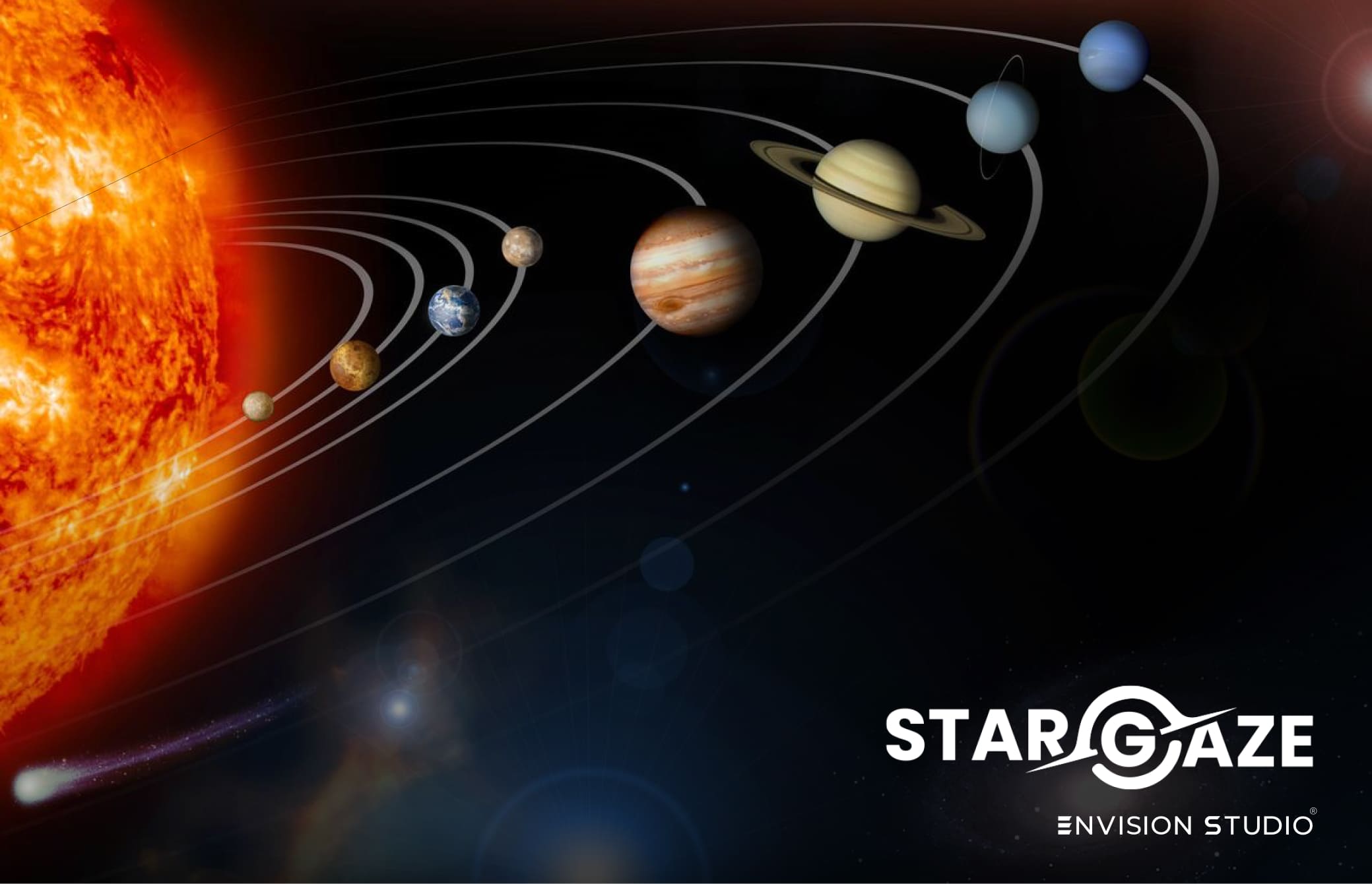
One star. Eight planets. Five officially recognised dwarf planets. Hundreds of moons. Over a million asteroids. Thousands of comets. That’s the real headcount of our solar system — far more crowded than most people picture when they think “planets.”
Most of that never makes it into a classroom textbook. The moons alone outnumber the planets by a wide margin, and new asteroids and comets are still being catalogued every year.
We Are Moving Faster Than You Think
Our entire solar system sits inside the Orion Arm of the Milky Way — a modest branch between two much bigger spiral arms called Sagittarius and Perseus. From there, the whole system orbits the centre of the galaxy at roughly 515,000 mph. At that speed, one full galactic orbit still takes about 230 million years.
Put another way: the last time our solar system completed a full lap around the galaxy, dinosaurs hadn’t appeared on Earth yet.
Only Two Spacecraft Have Ever Left
Since the 1950s, more than 300 robotic spacecraft have launched beyond Earth’s orbit to study the solar system. But only two — Voyager 1 and Voyager 2 — have actually left it, now travelling through interstellar space. Three more, Pioneer 10, Pioneer 11 and New Horizons, are still on their way out, decades into their journey.
Saturn Isn’t the Only Planet With Rings
All four giant planets in our solar system have rings — Jupiter, Saturn, Uranus and Neptune — along with at least one asteroid. None come close to Saturn’s, which remain the most spectacular rings in the entire solar system and the ones most people picture when they think of ringed planets at all.
Explore Solar System in AR — Not Just Read About It
Every fact above becomes something you can actually walk around with Stargaze XR. This is the easiest way to explore solar system in AR — place all 8 planets at true scale in your living room, explore 10 real spacecraft including Voyager, and examine the astronauts who first went looking for answers about what’s really out there.
Instead of reading about scale, you can stand next to it. Shrink Jupiter down to desktop size, then scale it up until it’s too big to fit inside your house. That’s the difference between reading a fact and actually understanding it.
🥽 Download on Meta Quest |
🤖 Free on Android |
🍎 Download on iOS
Frequently Asked Questions
How many planets are in our solar system?
There are eight official planets, plus five recognised dwarf planets, hundreds of moons, and well over a million asteroids and comets.
How fast does the solar system move?
Our solar system orbits the centre of the Milky Way at approximately 515,000 miles per hour, completing one full orbit roughly every 230 million years.
How many spacecraft have left the solar system?
Only Voyager 1 and Voyager 2 have actually left the solar system and entered interstellar space, out of more than 300 spacecraft that have explored beyond Earth’s orbit.
Which planets have rings?
All four giant planets — Jupiter, Saturn, Uranus and Neptune — have rings, along with at least one known asteroid, though none rival Saturn’s.
Can I explore solar system in AR for free?
Yes — Stargaze XR is free to download on Android (Stargaze Lite) and available on iOS and Meta Quest, letting you explore all 8 planets, 10 spacecraft and 7 real astronauts in augmented reality.
Facts sourced from NASA Science — science.nasa.gov/solar-system/solar-system-facts