

 stargaze_admin
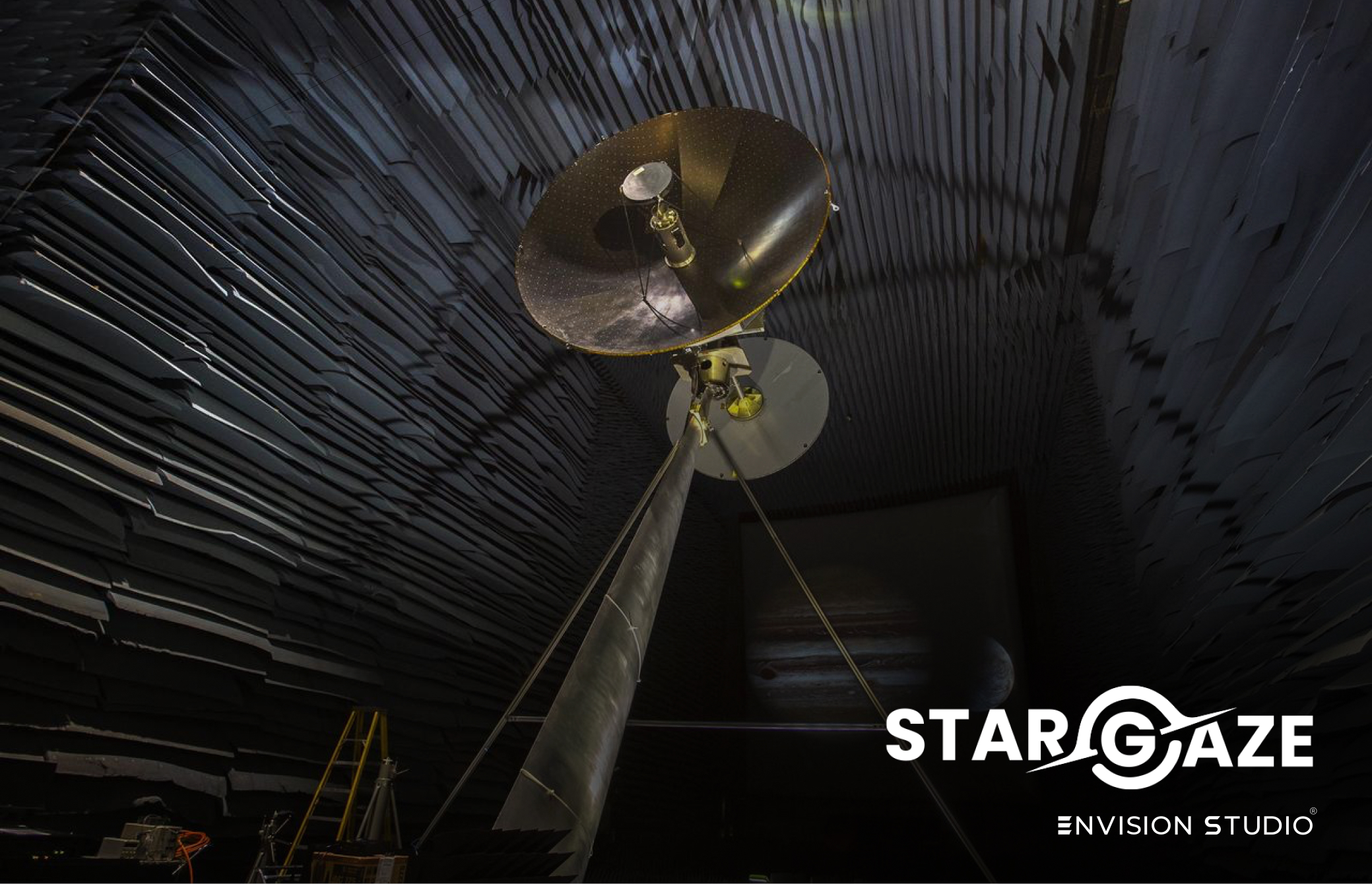
The Europa Clipper mission is carrying a message in 103 languages to a moon that might have more water than every ocean on Earth combined. NASA’s largest planetary spacecraft ever built is currently 1.8 billion miles into its journey — and it swings back past Earth on its way there. Here’s what it’s actually looking for, and what’s coming to Stargaze XR.
Why Europa, Specifically?
Europa is one of Jupiter’s moons — roughly the size of Earth’s own Moon — with an icy surface that scientists believe hides a vast subsurface ocean underneath. That ocean is thought to contain more water than all of Earth’s oceans combined. The Europa Clipper mission exists to answer one specific question: could that hidden ocean actually support life?
It’s worth being precise here — this is not a life-detection mission. It won’t find life directly. What it will do is determine whether the conditions for life — water, chemistry, and energy — actually exist there.
The Biggest Planetary Spacecraft NASA Has Ever Built
Europa Clipper launched on 14 October 2024 aboard a SpaceX Falcon Heavy rocket from Kennedy Space Center — and it is the largest spacecraft NASA has ever built for a mission to another planet. With its solar arrays extended, it spans more than 100 feet end to end, roughly the length of a basketball court, needed to collect enough sunlight at a distance more than five times farther from the Sun than Earth.
The Journey — 1.8 Billion Miles, Three Gravity Assists
Rather than flying straight to Jupiter, Europa Clipper is using a sequence of gravity-assist flybys to build up speed — first past Mars, then back past Earth in December 2026, before finally reaching Jupiter in April 2030. The entire journey covers roughly 1.8 billion miles.
Once it arrives, the spacecraft will orbit Jupiter and perform nearly 50 close flybys of Europa over its mission, at times descending to just 16 miles above the moon’s surface — using nine science instruments to scan nearly the entire moon for signs of a habitable environment.
A Message for Whatever’s Out There
Europa Clipper carries something unusual: a tantalum plate engraved with sound-wave representations of the word “water” spoken in 103 different languages, alongside a poem written specifically for the mission. It’s a small, deliberate gesture — a message riding along on a spacecraft built to ask whether anything could exist out there to receive it.
What This Means for Stargaze XR
Europa Clipper’s Earth flyby puts it briefly, genuinely close to home in December 2026 — a real-time reminder that this mission is actively in progress right now, not a distant future plan. We’re looking at bringing Europa Clipper and Jupiter’s moon system into Stargaze XR’s Missions section, so you can explore the spacecraft and the moon it’s investigating at true scale in AR.
🥽 Download on Meta Quest |
🤖 Free on Android |
🍎 Download on iOS
Frequently Asked Questions
What is the Europa Clipper mission looking for?
The Europa Clipper mission is investigating whether Jupiter’s icy moon Europa has the conditions — water, chemistry, and energy — necessary to support life, though it is not a direct life-detection mission.
When did Europa Clipper launch?
Europa Clipper launched on 14 October 2024 aboard a SpaceX Falcon Heavy rocket from Kennedy Space Center, and is expected to arrive at Jupiter in April 2030.
When does Europa Clipper fly by Earth?
Europa Clipper performs an Earth gravity-assist flyby on 1 December 2026, using our planet’s gravity to help propel it onward to Jupiter.
How close will Europa Clipper get to Europa’s surface?
Europa Clipper will perform nearly 50 flybys of Europa, with some passes as close as 16 miles above the moon’s surface.
Mission facts sourced from NASA JPL —