

 Imeth Sahabandu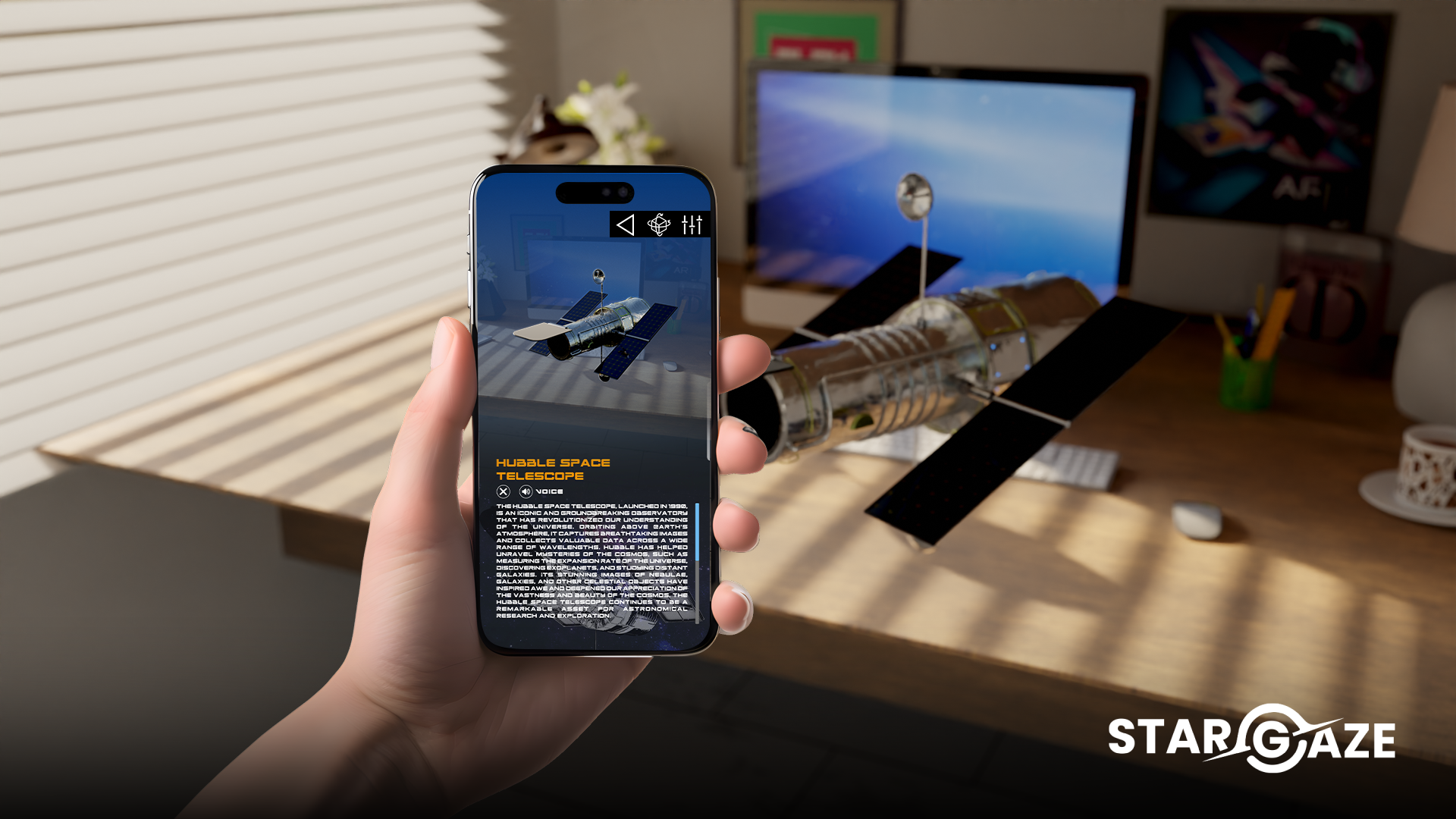
Augmented reality space education is changing everything about how students, teachers and space enthusiasts interact with the cosmos. For decades, learning about space meant textbooks, static images and occasional planetarium visits. In 2026, all of that has changed — and the universe is now available in the palm of your hand.
This guide explores exactly how augmented reality space education is transforming learning, which tools are leading the way, and how you can get started for free today.
👉 Download Stargaze AR free now: App Store Free | App Store Premium | Google Play Free | Google Play Premium | Meta Quest
1. How Augmented Reality Space Education Brings the Universe to Life
Traditional space education has always faced the same fundamental challenge — space is impossibly vast and the tools available to visualize it have always been limited. A photograph of Jupiter in a textbook gives you a flat static image. An augmented reality space education app places a photorealistic rotating three-dimensional Jupiter directly in your living room at whatever scale you choose.
The shift this creates for learners is profound. When a student can hold Saturn in their hands, rotate it to see the ring structure from above and below, zoom into the cloud bands, and compare its size to Earth side by side — they are not reading about space. They are experiencing it.
Stargaze AR is at the forefront of this augmented reality space education revolution. Available free on iOS, Android and Meta Quest, Stargaze places the entire solar system — planets, spacecraft and astronauts — directly into the real world through your device camera.
2. Augmented Reality Space Education for Every Age Group
One of the most powerful qualities of augmented reality space education is its ability to work across every age group simultaneously. A single AR space application can engage a 5-year-old discovering planets for the first time and a 15-year-old studying orbital mechanics for their science exam.
For young children aged 5-8: Augmented reality space education at this age is about wonder and discovery. Seeing a photorealistic Mars appear on the kitchen table creates a memory and emotional connection to space science that no textbook can replicate. Stargaze AR’s intuitive interface means children this age can explore independently from the first moment they open the app.
For students aged 9-14: At this age augmented reality space education becomes a genuine learning accelerator. Students studying the solar system can compare planet sizes accurately in 3D, understand orbital distances, and examine spacecraft like the Hubble Telescope and Voyager in interactive detail. Stargaze AR’s real astronaut models — including Neil Armstrong, Yuri Gagarin and Valentina Tereshkova — bring the human story of space exploration to life.
For older students and adults: Augmented reality space education at this level supports deep engagement with space science concepts — the relative sizes and distances of planets, the design and mission of specific spacecraft, and the diversity of astronauts who have explored space all become tangible and memorable through AR.
👉 Download Stargaze AR free on the App Store 👉 Download Stargaze AR free on Google Play
3. How Augmented Reality Space Education Is Transforming Classrooms
The classroom is where augmented reality space education is having its most significant impact. Teachers worldwide are discovering that AR space tools like Stargaze transform passive science lessons into active participatory experiences that students genuinely look forward to.
A teacher introduces the solar system unit. Instead of turning to a poster on the wall, they open Stargaze AR on a tablet and place a virtual solar system on the classroom floor — large enough for students to walk between the planets. Each student then opens Stargaze on their own device and explores individually — rotating planets, examining spacecraft, reading about astronauts.
Studies on augmented reality space education consistently show improved knowledge retention, higher student engagement, and stronger conceptual understanding when AR tools are used alongside traditional teaching methods.
Stargaze AR is already being used in classrooms across Asia, Europe and North America as an augmented reality space education tool for STEM curricula. It requires no special equipment beyond a smartphone or tablet — making it accessible to virtually every school and family.
4. Augmented Reality Space Education Beyond the Classroom
Augmented reality space education doesn’t stop at the school gates. Some of the most powerful learning happens outside formal education — in homes, libraries, science centres and museums.
At home: Parents use Stargaze AR as an augmented reality space education tool during family time — turning dinner table conversations about space into interactive explorations. Children who might never visit a planetarium can experience the solar system in their own living room.
In science centres and museums: AR space experiences create interactive exhibits that visitors can engage with on their own devices — no installation or maintenance required beyond the app download.
For independent learners: Space enthusiasts of all ages use augmented reality space education apps like Stargaze to deepen their understanding of the cosmos at their own pace from anywhere in the world.
For the most immersive augmented reality space education experience beyond smartphones — download Stargaze on Meta Quest and step fully inside the solar system in full virtual reality.
5. The Future of Augmented Reality Space Education
Augmented reality space education is still in its early stages — and the trajectory is extraordinary.
Full VR space classrooms: Already available through Stargaze on Meta Quest, full VR space education allows students to step inside the solar system rather than viewing it through a phone screen. Walking on the surface of Mars, standing next to a life-size Saturn, exploring a spacecraft interior — these experiences are available today.
Real-time space data integration: Future augmented reality space education apps will integrate live data from space agencies — showing the current positions of planets, active mission telemetry, and real-time astronomical events overlaid on the physical world.
AI-powered space guides: Intelligent virtual guides will accompany learners through augmented reality space education experiences — answering questions, adapting to learning pace, and personalising the journey through the cosmos.
Collaborative AR classrooms: Students in different locations will explore the same AR space environment simultaneously — enabling global collaboration in augmented reality space education experiences.
Why Stargaze AR Is the Best Augmented Reality Space Education Tool in 2026
Among all the augmented reality space education tools available in 2026, Stargaze AR stands apart for five clear reasons:
1. The most comprehensive content — 10 planet models, 10 spacecraft models and 7 real astronaut models provide the richest augmented reality space education content library available in a single app.
2. Available on every platform — iOS, Android AND Meta Quest — Stargaze is the only augmented reality space education app covering smartphones, tablets and VR headsets in one package.
3. Free to download — The free version provides meaningful augmented reality space education content immediately with a premium upgrade for the complete experience.
4. Designed for all ages — From 5-year-olds to adult space enthusiasts, Stargaze AR’s interface and content scale to every level of learner.
5. Built by world-class XR developers — Stargaze AR is developed by Envision Studio — a full-service XR development company with a portfolio spanning government institutions, global enterprise brands and consumer app markets worldwide.
Frequently Asked Questions — Augmented Reality Space Education
What is augmented reality space education? Augmented reality space education uses AR technology to overlay 3D planets, spacecraft and astronauts onto the real world through smartphones, tablets or AR glasses — making space science interactive, immersive and accessible to learners of all ages.
Which is the best augmented reality space education app? Stargaze AR is the best augmented reality space education app in 2026 — featuring 10 planet models, 10 spacecraft, 7 real astronauts, and availability across iOS, Android and Meta Quest.
Is Stargaze AR free for schools? Yes — Stargaze AR has a completely free version available on both the App Store and Google Play, making it accessible for every school regardless of budget.
What age is augmented reality space education suitable for? Augmented reality space education tools like Stargaze AR are designed for all ages from 5 to adult. The intuitive interface works for young children while the depth of content supports older students and adult learners.
Does augmented reality space education work on Meta Quest? Yes — Stargaze AR is available on Meta Quest, providing a fully immersive VR space education experience that goes far beyond what a smartphone screen can offer.
How does augmented reality improve space education? Augmented reality space education improves learning by making abstract concepts tangible — students can see accurate planet sizes, examine spacecraft in 3D detail, and experience the scale of the solar system in a way flat images and videos cannot replicate.